
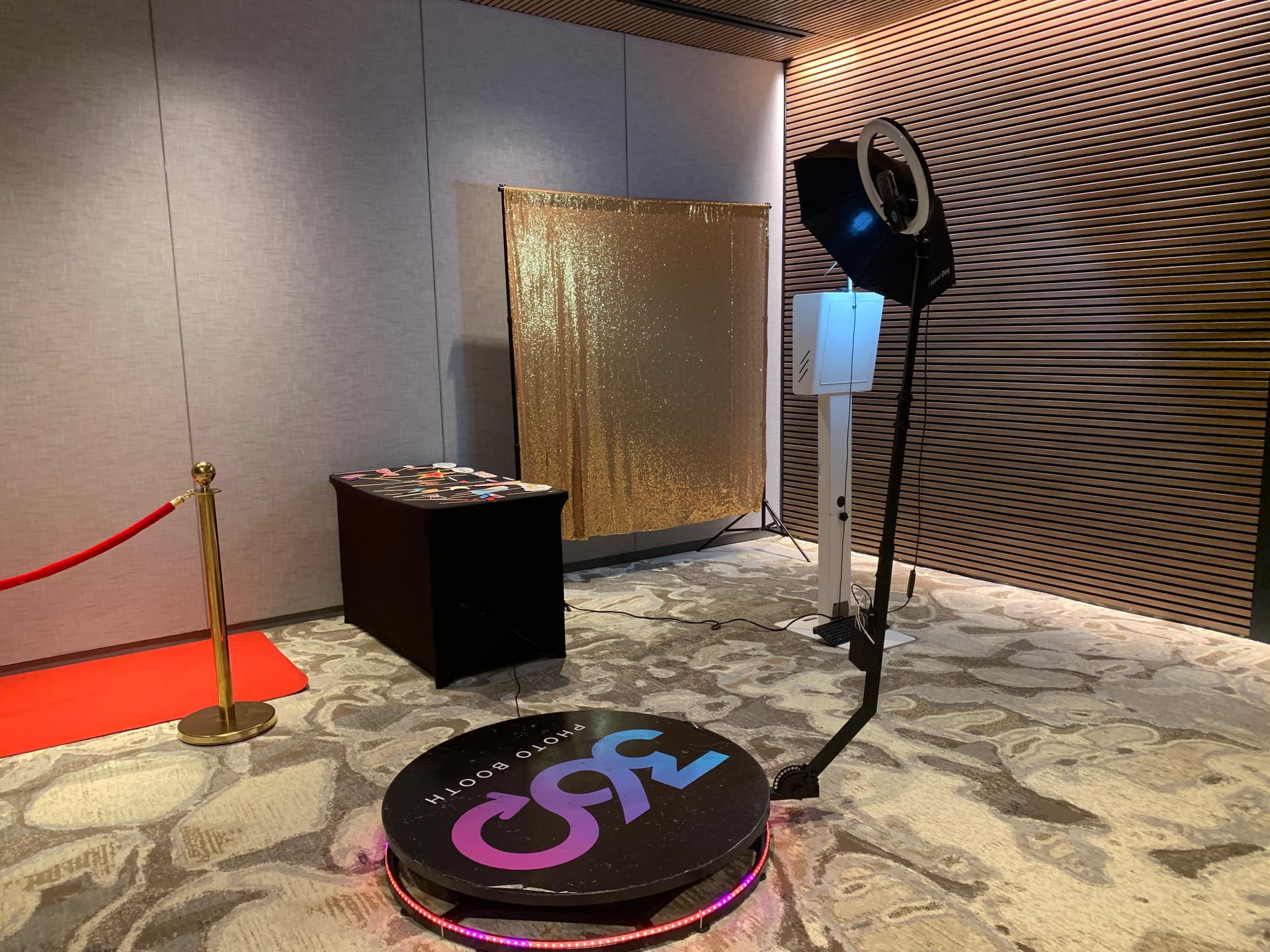
You have budget for one booth and one corner of the room. The 360 video booth is the one your guests have seen on their phones. The open air print booth is the one they have actually used. Pick wrong and it shows up as a stalled line at 8 p.m., or an expensive platform nobody is standing on.
What guests walk away with
A 360 booth gives each group a short slow motion video with your overlay and one song, delivered by QR code or text. There is nothing to hold. The clip lives on a phone and usually reaches Instagram before the group steps off the platform.
An open air print booth gives every guest a 2x6 strip in hand about ten seconds after the last frame. Digital sharing is included, but the strip is what people keep. It is also the only one that feeds a guest book table, where guests tape a strip beside a note.
Floor space and ceiling clearance
This is where most plans break. A 360 booth needs roughly 10x10 feet of clear floor, and that is not the platform itself. It is the arm sweep, the safety gap, and the ring of people standing there watching. Squeeze it into a 10 foot alcove and the attendant spends the night asking guests to step back.
An open air booth needs about 8x8 feet, backdrop included, and it can sit against a wall, which a 360 setup cannot. Ceiling height matters for the 360, because the camera arm travels above head height. It almost never matters for the print booth, which stays well below a chandelier.
Questions worth asking the venue before you sign:
- How much clear floor is in that exact spot, measured rather than guessed:
- Ceiling height there, and any beams, sprinkler heads or low light fixtures:
- Is there a standard outlet within reach, and is that circuit shared with the DJ:
- Does the room get reset during the night in a way that moves the booth:
- Do you require a certificate of insurance, and by what date:
What the line looks like
A 360 booth serves one group at a time. Each ride runs about 20 to 30 seconds, plus loading, unloading and a moment for the clip to process. It is a performance, so people gather to watch, good for energy, bad for throughput. At a 150 guest reception, expect a real line during the busy stretch and some guests who skip it.
A print booth moves faster. A session is three or four frames in under a minute, and the strip prints while the next group is already stepping in. Groups are bigger too, since an open air setup fits six or eight people in frame instead of two or three on a platform.
If getting most of your guest list through matters, the print booth wins on math. If the booth is meant to be a moment people gather around, the 360 wins.
The cost at 2, 3 and 4 hours
Peek-A-Booth prices both flat, with delivery, setup, teardown, an attendant and a certificate of insurance included:
- 2 hours: Open Air $400, 360 Video $500
- 3 hours: Open Air $550, 360 Video $700
- 4 hours: Open Air $700, 360 Video $900
- Extra hour: Open Air $150, 360 Video $200
The gap widens as the night runs longer, from $100 at two hours to $200 at four. A 3 hour 360 booth costs the same as a 4 hour open air booth. Three hours is usually enough for a 360 anyway, since the novelty pulls hardest in the first ninety minutes.
Honest limits
Peek-A-Booth does not run a mirror booth, a high speed camera arm, or green screen. If your plan needs one of those, book it elsewhere. If prints do not matter and budget is tight, the Digital Photo Booth starts at $300 for 2 hours and has the smallest footprint of the three.
One last practical note. Book the hours around when guests are actually free, not around the full event window. A booth running through dinner and speeches is a booth running for nobody.